Tuesday, February 5, 2008

The Quality of This Land

After returning from Tierra del Fuego I am often asked the question is it a beautiful place? It’s not an easy question to answer; my response, at least in my head, is to ask what makes a place beautiful? I wonder: must a place have obviously awe-inspiring features like a mighty mountain, or plunging, pristine waterfall to earn our respect? Or can we appreciate land like we do most people, not with a glance but with a relationship? Are there as many scales of beauty for land as there are among people?

The part of Tierra del Fuego in which we work shows beauty in a “normal” way. At times, golden sunlight on low, grassy hills, rolling down to the sea along the shore of Bahia Lomas or the Strait equals the beauty of any other seaside vista. That said, I believe the real beauty of this land lies in something not seen in a glance from the window of a car or airplane. It unfolds as you get to know it. For me, the beauty of this land lies buried within the very real organic connection of land, sea and sky.

Tierra del Fuego

Looking north at the Straits of Magellan from the low hills that give Bahia Lomas its name

Imagine a wind that rises from nothing and in seconds turns into a monstrous force. It can rough-up the sea into white foam that rides on a rolling swell so deep that it even rocks a ferry carrying tanker trucks. Yet all around you are sunny skies with dreamy clouds, not a dark one in sight.

Tierra del Fuego

The Straits of Magellan whipped by a 60 mph wind on a sunny day

At such times you would think the sea could get no worse. Then the tide turns and the two gigantic forces, wind and tide, starting fighting each other. The tide here is awesome. At low tide you can stand on top of the cobble beach staring down a steep muddy slope to a trickle of a river and think it impossible that the sea could fill up such an immense space. Yet it does, relentlessly and with a rush. We’ve seen walls of water rushing from the open sea filling river channels 30 feet deep in a few hours, only to see them drain away again in an endless cycle.

Tierra del Fuego

The tide fills a river on the edge of Bahia Lomas


Tierra del Fuego

Jerry walking along the shore of the Strait of Magellan at low tide

We have ridden our ATV to the outermost edge of the intertidal flats of Bahia Lomas at low tide, an amazing 6 km from the high tide line. Out there, the sea appears peaceful, in no way threatening. Then the tide starts moving. At first it comes slowly, crawling across the mudflat, filling in the minor contours that seem only to appear when the tide fills them. It keeps picking up speed, at times so fast you would have to walk briskly to keep up. Then it dawns on you that the flat that appears to be without relief is actually bisected by many small creeks which fill so fast that you may be cut off, trapped in a world of ever-deepening sea. Inches of water turn to feet in minutes, tens of feet in hours.

Tierra del Fuego

Looking at the shore of Bahia Lomas on an outgoing tide

Sometimes you will bask in warm sun, stripping off outer garments wondering why you ever even brought them in the first place. At the sea edge you can still see the Andes looming large in the distance and beneath them are tiny clouds. Within minutes those distant innocuous clouds fill the sky around you but are now dark and threatening. Without sun, the air turns as cold as a NJ winter day and although it never rains hard, wetness starts to drift in the winds and cuts you through. The sea grows choppy, the wind freshens. You feel the power of nature unleashed like few other places in the world.

Tierra del Fuego

A storm threatens Bahia Lomas on a spring tide

At the same time, this land opens its arms with a mother’s love. Though not rich in bird species, many that do occur are very special. Only a few are globally rare, like the ruddy-headed goose or Magellanic plover. That must be because the land is vast and the habitat it has to offer changes little from place to place. Therefore whatever birds are present are common and widespread. This year was special because David and Jerry brought with them their indefatigable passion for birding that infected us all. Through their eyes one can understand this unique quality of the land, many species found here are unusual but have received little scientific scrutiny. This includes endemic species like the Fuegian snipe, the chocolate-vented tyrant, and even the ever-present least seedsnipe.

Tierra del Fuego

Guanacos in evening


For me the sea, wind, sky and animals are not separate features of the land but, along with the land, they are an entity, a life, a spirit within which lies a wondrous beauty that I cannot easily describe. But I feel it, as does our team. For the most part we are all conservationists; our main goal here is to help save a species that, oddly enough, barely survives because of unstoppable greed 8,000 miles away. We’ve done our best to fight that battle by provided vital information to help untangle the many threads of the red knot’s complicated plight. I can’t say we’ve had much success protecting the red knot but fortunately after seven years this land and its people have given us more than we expected: a land of beauty that springs from the transparent interaction of life and the naked power of wind and sea.
This year, with the help of many Chileans, and supporters from the US we will begin construction of the Tierra del Fuego Bird Observatory on the shores of the Strait of Magellan. With luck we can help create a partnership between Chilean and US groups and add something to a growing conservation program in Bahia Lomas by native Chileans. I will write more about this in later blogs.

Sunday, January 20, 2008

Tierra del Fuego: 1/20/08

Our Seventh Expedition to Tierra del Fuego: 1/20/08

Our Friday morning started by saying goodbye to Sergio and Gabriella, the veterinary students from University of Santo Thomas. Their major professor is Carmen Espoz. Carmen left the night before. We were sorry to see them go; they are hard working intelligent people who are always willing to lend a hand. Now we have a team of 7 people, small but adequate.

Tierra del Fuego

(Carmen with her daughter Antonia.)


While working on the catch of Magellanic Oystercatchers, Ricardo found a new roost for red knot, the oddest one we had ever encountered. Shorebird roosting sites are usually straightforward. Night roosts are usually far away from land and isolated by water to provide a defensible perimeter from ground predators. During the day they choose areas with good visibility to provide reasonable forewarning of approaching birds of prey.


Tierra del Fuego

(Daytime roost of red knots along Bahia Lomas (Photo by Ricardo Matus))


In Bahia Lomas knots and godwits often roost just at the waters edge and roll forward with the advancing tide, until it peaks. Afterwards they move back with the ebbing tide. At Bahia Azul on the Strait they roost on a spit of land between a small river and the sea, and move up and down the slope of the spit. It’s only at the spring tides, those high tides that flood all of the inter-tidal flats, that the shorebirds find the need to roost on the highest ground mostly dominated by two species of salicornia. It is dangerous to be on the salicornia, Patagonian fox patrol it regularly hunting roosting birds.


Tierra del Fuego

(Daytime roost of red knots and Hudsonian Godwits on the edge of salicornia on Bahia Lomas during a spring tide.)


Ricardo found the roost at least a kilometer from the high tide line which is amazing by itself. Even more amazing, nearly the entire population of the west side of Bahia Lomas roosted in one small isolated patch of salicornia. 3,000 red knots sat happily only 100 m from the high ground. The reason was the wind.


Tierra del Fuego

(Knots roosting in salicornia along Bahia Lomas far from the waters edge)


The previous three days a strong wind from the west blew towards the sea. On Wednesday it blew hurricane force. On Thursday the wind fell to a slightly more moderate 40 mph. On our first visit to the site we found small clusters of knot droppings on the lee side of the salicornia clumps. Such places afforded a little shelter and the proximity of the high ground cut the wind more. At the level of the birds there was virtually no wind.


Knowing all this still does not assure a catch. The wind had died down overnight and was now a more modest 20-30 mph which is high but not abnormal for Tierra del Fuego. More importantly we had attempted many catches on salicornia in the past, all failures because it was just too difficult to set the net in the right position and the birds were virtually impossible to move in the right direction. Could we set our net in the right place? Could they be moved without flying far away? Would the birds return now that the wind had slowed; they might prefer to roost along the waterline.


Tierra del Fuego

(Daytime roost along the straits of Magellan at Bahia Azul in 2007)


The team set the net in good time, but it was slow work because we had to hack out a trench for the net in rock hard ground. In the midst of net-setting a small group of godwits and knots flew over our heads swinging around and landing not 200 m from our net. After a chaotic rush to finish setting the net and move equipment, we were ready. In the meantime the 3,000 knot flock had arrived and we began the process of twinkling them into position.


But they wouldn’t move into the catching area in front of the net. This is an area of about 10 x 23 m in to which birds must be induced to go if they are to be caught. Humphrey, Ricardo and I tried repeatedly but the birds would always move from one side of the net to the other, always avoiding the catching area.


Our problem was obvious. To be safe we used very obvious piles of rock to mark the catch area and the danger zone, a 2 meter strip in front of the net that must be clear to avoid hitting birds with the net. We also placed two wooden decoys to draw birds into the area. It was clear that the birds were being put off by the markers and decoys so we removed the decoys and reduced the size of the markers.


Within 20 minutes, we made a catch, a wonderful catch, onefor the records. We caught and processed 201 red knots, and probably caught another 20 or so that made their way out of the net before we could secure it. Although we worked until 11:00 pm processing the catch we went back to camp happy and satisfied because we had met our major objective. Anything else would be gravy.


Tierra del Fuego

(Larry, Steve, Humphrey, Ricardo, Gerry and David processing catch of knots. processing catch of knots ( Photo by Mandy Dey))


Labels: , ,

Friday, January 18, 2008

Tierra del Fuego: 1/18/08

Our Seventh Expedition to Tierra del Fuego: 1/18/08


Guy Morrison and Ken Ross carried out their recount but found no more knots than on their first aerial count of the bay. They plan to fly a third time to confirm the count but already it seems certain that the red knot population in Bahia Lomas has fallen by a further 30% over the past year. It’s premature to ask why, but along with declines in other wintering areas, it appears that the red knot population may be in greater danger than it was only a year ago.


In 2004, a paper published in the Proceedings of the Royal Society in Britain projected that the rufa subspecies of the red knot could become extinct by 2010. Stable numbers over the past few years have suggested that this prediction was unduly pessimistic. In light of this year’s surveys, however, extinction within a very few years seems quite possible. We will know more by the end of the expedition.


Tierra del Fuego


Our work goes well. On Tuesday the 15th we set our net at a new site half way between our old camp along the extensive flats on the west side of the bay and Punta Espora where the Straits of Magellan become narrow. We named the site the Twin Hills minefield after the two small hills that bookend a fenced-off active minefield that borders the beach. The site had great promise (as long as we didn’t attempt to cross the fence!). Guy Morrison and Ken Ross saw knots and godwits there on their Sunday aerial survey flight and we found similar numbers on Monday, but on that occasion we arrived too late to set the cannon net so we decided to attempt a catch there on Tuesday.


Tierra del Fuego

(Sign marking mine field behind beach at Twin Hills mine site)


Four peninsulas of rock projecting into the sea make it a perfect roosting site for knots, Hudsonian godwits and Magellanic oystercatchers. A steep beach makes for easier cannon netting because the tide heights are much less difficult to predict than the almost imperceptible slope of the flats across the rest of Bahia Lomas. Using a technique developed by Clive Minton we established the likely level of the next high tide compared with the previous one. It requires two people, one at the old tide line, the other marking a point on their leg equal to the difference in the tides. In this case it was 6 inches. The person at the old tide line must lie down so that one eye is almost on the ground and direct the other person to move closer or further away until the mark on their leg aligns with the horizon beyond. At that point the person stands at the estimated new high tide line.


Tierra del Fuego

(Magellanic Oystercatchers and behind them Hudsonian Godwits on the Twin Hills site.)


The team set the net and after some difficulty we caught 90 birds, of which 36 were knots. We caught 50 white-rumped sandpipers and four Hudsonian godwits. The SAG and USDA staff joined us and our processing went fast and well.


Tierra del Fuego

(Mike from USDA and Julisa from SAG samping a white rump for Avian Flu)


Tierra del Fuego

(Claudio from Wildlife Conservation Society and Daniel from SAG sampling birds for Avian Flu)


Tierra del Fuego

(Antonia daughter of Carmne Espoz holding a hudsonian godwit)


The next day a ferocious wind descended on the area. Gauges on the ferry at the narrows clocked hurricane force winds of over 70 miles/hour. Needless to say the wind narrowed our options considerably. In the end we decided to abandon an attempt to catch and spent time at base camp preparing for the following day.


Tierra del Fuego

(Mist net blown by wind storm on Bahia Lomas.)


The next day, Thursday, the winds had fallen to a still considerable 30+ mph, a speed that would rule out netting in most places. We decided to go back to the Twin Hills minefield because the roost was in the lee of the hills and the winds, though gusty, would not be a problem. The knots did show up, but soon left, and we were forced to go on to plan B. A flock of over 500 Magellanic Oystercatchers roosted at the site and there was no better time to go after them. After a brilliant “twinkle” by Humphrey and Ricardo, we had 85 oystercatchers in the net. With their bright orange-red bills, yellow eyes and pied plumage, they are marvelous birds in the hand. We soon discovered that they must also be remarkably tough because several had old injuries or deformities that they had obviously learned to live with. One had a foot missing; another had elongated and crossed mandibles; another’s bill bent to the right. In the field, the Magellanic oystercatcher’s call seems high-pitched and thin, but when some of the birds objected to being handled, their calls were ear-splitting. We all enjoyed the experience of getting up-close and personal with such a striking and charismatic species.


Tierra del Fuego

(Camouflage net on at the Twin Hills site)


Tierra del Fuego

(Humphrey holding a Magellanic Oystercatcher.)


Tierra del Fuego

(Ricardo, Mandy and Gabriella processing oystercatchers)


Tierra del Fuego

(David holding a Magellanic Oystercatcher.)


Previous entries for this expedition: 1/14/08

1/12/08


Labels: , ,

Monday, January 14, 2008

Tierra del Fuego: 1/14/08

Our Seventh Expedition to Tierra del Fuego: 1/14/08


Humphrey and I left Punta Arenas early to survey the area along the Strait of Magellan at high tide. We left our comfortable digs at the Hotel Noriega at 7.00 am, leaving the rest of the team to pull together all we would need for the first leg of our three week field trip. Fortunately Jorge Jordan and his staff lent us a hand, gathering equipment left since last year, helping to arrange hard-to-get supplies as well as organizing rooms at the hotel.


Tierra del Fuego

(Jorge Jordan and Mandy at Jorge’s Hotel Noriega)


On arriving on the Strait, we found far fewer red knots than we had seen last year. This may not mean much; after 7 years of fieldwork, we have grown used to frequent shifts in their roosting sites and feeding habitats. Last year we documented a significant new roost along the narrows, which was particularly suitable for cannon netting because of the steeply sloping beach. The knots feed on mussels, and move up to the roost site at high tide. The gentle gradient of the wide flats of Bahia Lomas, 6 km from high tide to low tide in some places, makes it very difficult to predict where the 30 ft high tide will ebb. The bay’s 60 mile waterfront creates a second dimension allowing birds to roost anywhere they want making cannon netting virtually impossible.


Tierra del Fuego

(Looking out over the flats of Bahia Lomas)

With no birds at the Strait we had little choice but to forego cannon netting and use our mist nets; we did this reluctantly because just as the tide is extraordinarily unpredictable so is the weather. Mist netting works best on dark nights with the nets set over the high tide line. We try to set the nets so that the innermost net is just below high tide and the outmost net lies over water about 3 feet deep. True to their name, when their low tide feeding areas are covered, shorebirds tend to fly over the water parallel to the shoreline as they move to their nighttime roost sites. Mist nets set properly should cross their paths so that the birds are caught in the fine mesh. If the tide floods too far, there is a danger that birds caught on the outer nets will hang low into the water and possibly drown; if the tide stops short of the nets, few birds will be caught because they do not usually fly over dry mud.


Tierra del Fuego
(Walking in 70 mph winds on the shore of Bahia Azul)


Fortunately the SAG/USDA team assisted ours and the 12 nets were set in quick time. Unfortunately we caught few birds: 6 two-banded plovers and 5 white-rumped sandpipers. The tide fell short, leaving all but the outer four nets out of the water. But strangely we heard few birds, only the plaintiff whistles of the Magellanic oystercatchers. The raucous nighttime sounds of roosting godwits and knots were altogether missing.


Tierra del Fuego

(A Knot feeding on a mussels on the Bahia Azul site)


The next morning, Sunday, Guy Morrison gave us preliminary results of the first aerial survey, a disappointing 8000-10,000 knots which pointed to a possible 30% decline over last year’s count for the same area. With such a low figure, Guy and his counting partner, Ken Ross, decided to confirm the result by carrying out a second count the next day. Guy also told us of a new roost on a beach beside a fenced area with land mines in Bahia Lomas just south of the Strait. We decided to discontinue mist netting and attempt a cannon net catch at the new site.


Tierra del Fuego

(Survey plane with Guy and Ken rounding Punta Espora)


Labels: , ,

Saturday, January 12, 2008

Tierra del Fuego: 1/12/08

Our Seventh Expedition to Tierra del Fuego: 1/12/08


Our seventh expedition to Tierra del Fuego began with an early evening arrival at Punta Arenas Airport. This small city has either grown more attractive over the last 7 years or we have gradually awakened to its often subtle qualities. Chile has grown more integrated into the world economic system in the last seven years, even establishing a free trade agreement with the US. There are a few chain stores, but even those give a cosmopolitan feel as they are Chilean or European rather than US. I don’t remember coming across a McDonalds. Gone are the days we needed a satellite phone, cell phones are used widely and at least in Punta Arenas broadband internet access pops up everywhere. All of this has made the preparation for our expedition less difficult and our field work more comfortable.


Strait of Magellan

(Looking out over the shore of the Strait of Magellan towards the Andes on our approach to Punta Arenas Airport)


That said we are still about to face off with one of the most infamous bodies of water in the world. The Straits of Magellan still strikes fear in the heart of serious mariners with its often violent wind storms and fearsome 8-knot currents. This may not sound bad but if you are sailing a sailboat with hull speeds of 7 knots, it mean you go backwards. Even modern tankers with speeds of 15 knots must wait for favorable tides. On the ground we must always keep our eye on the barometer. A sudden plunge forecasts wind storms that can blow down tents or render mist nets useless. Last year a sudden storm at night created a truly harrowing experience as we dealt with a big catch in the mist nets over wind blown tide that threatened birds and biologist alike.


Tierra del Fuego

(70 mph winds sweeping the Strait in 2007)


What can be said about the improvements in Punta Arenas cannot, unfortunately be said about the red knot populations. Although last year’s count during northward migration on the Delaware Bay remained unchanged, recent counts on the wintering areas suggest much lower numbers. In November, Dr. Allan Baker, Patricia Gonzalez and Luis Benegas reported a big drop in numbers at Rio Grande in the Argentinian part of Tierra del Fuego with the count dropping from around 3,000 birds to 1,500. The count our team conducted over the New Year on the west coast of Florida proved equally disturbing. Where two years ago we counted over 2,000 knots, we found only 550. Therefore the count in Tierra del Fuego will be critical.


Knot flock
(Knot flock landing on the shores Bahia Lomas in 2007 ( photo by Mark Peck))

So the first goal of our work this year is to continue our surveys of knots. Guy Morrison and Ken Ross from the Canadian Fish and Wildlife Service will carry out an aerial count of red knots in the entire area and we will conduct ground counts in our Bahia Lomas study area. We will also trap knots to top-up the proportion of the population carrying bands in order to support our re-sightings program which is designed to help develop estimates of population-size, survival, residency periods etc. All of this work is only possible because of financial help from the US Fish and Wildlife Service through Brad Andres. Third we will team up with the US Department of Agriculture and its Chilean counterpart Servicio Agricola Granadeiro to catch birds to for the surveillance of avian influenza. We will also train the Chilean biologists to catch birds.


cannon net

(Cannon net firing in 2007 over red knots at Bahia Azul with camouflage kelp in air.)


An interesting new goal of our trip this year will be to catch Magellanic oystercatchers and band them with color bands to distinguish individual birds at a distance. The “Magic Oystercatcher” aroused the interest of many of our colleagues after Dr. Allan Baker presented a paper on the “Definitive Phylogeny of the Oystercatchers” at the International Wader Study Group conference in France in October. He described three main ancestral groups: the old world oystercatchers, the new world oystercatchers and the Magellanic oystercatcher”. Biologists in both Chile and Argentina intend to focus on this most distinctive of the world’s oystercatchers, so our plan to catch and mark a sample is a contribution to this new study. Similar studies take place in the US on American oystercatchers.


Olivia

(Olivia Blanc holding a Magellanic Oystercatcher caught in 2002)

Finally and most importantly we will continue to pursue our plan to build “The Tierra del Fuego Bird Observatory”. Much has been accomplished in the last year. With the help of Charles Duncan of the Western Hemisphere Shorebird Reserve Network at Manomet Center for Conservation Science, and the Conserve Wildlife Foundation of NJ we now have sufficient funds to start building. Jorge Jordan in Puntas Arenas has used his business expertise to help develop a new non-profit foundation with a board of directors that will oversee the building of the new observatory. The mayor of the Primavera Municipality Senor Ricardo Olea and his deputy, Senor Herrera, will contribute by arranging to move an existing house to the Bay that will be renovated with the project funds. All the elements will soon be in place to start moving dirt, a dream soon to become reality.


Observatory

(Site of the Tierra del Fuego Bird Observatory)


To the same end, we have invited the participation of NJ Audubon Society to help create a meaningful link to the US. Dr. David Mizrahi will participate in this year’s expedition for the purpose of exploring a role for NJ Audubon in relation to the TdF Bird Observatory. He too is sending blogs to the NJ Audubon website

This year’s teams includes Dr. Amanda Dey, Senior biologist with NJ Division of Fish and Wildlife, Dr. Humphrey Sitters of the International Wader Study Group, Steve Gates a volunteer who has participated and supported our expeditions to the Arctic and TdF as well as our work in the Delaware Bay, and Jerry Binsfeld a retired railroad man from Canada and a volunteer on our Arctic and Delaware Bay expeditions.

Labels: , ,

Saturday, December 1, 2007

Australia - Large-mesh Cannon Nets - 80 Mile Beach, WA, November 20, 2007

Ghost Crab holes, and the sandy remains of excavation, on 80 Mile Beach


Our first catch at 80 Mile Beach, in the late afternoon, gave all of us a real sense of accomplishment.
After two days of experimenting with small-mesh nets (setting one high and one low), the team leaders, Clive, Roz and Chris decided to go back to the same method that has proved successful in the past -- two large-mesh nets set at the same level of the tide. It was a tough call for several reasons . . . . .

The small-mesh net, the standard on the
Delaware Bay, is made of small mesh that prevents birds from getting entangled so extraction is relatively simple. On direction, the team first secures the sides of the net with sand or rocks so birds cannot escape, then at the water's edge they lift the net so birds can walk up-beach to the back of the net. Afterward they are covered with shade cloth.


At water's edge, the team begins to lift a small-mesh net to allow birds to walk up-beach to the back of the net after a capture on Roebuck Bay


Although small-mesh nets have always been around, lighter materials have allowed them to grow in size, now about 22 meters by 10 meters, without growing in weight. Weight has two impacts. First, it causes the net to deploy poorly especially in an opposing wind. Second, if the birds are caught near the water line, the weight of the net could cause birds to drown, especially small birds. The small mesh exacerbates the problem because the birds can’t pop their heads through the mesh. Overall, however, lighter material has made small-mesh nets more versatile and the ease of extraction greatly reduces risk to the birds.


A small-mesh net caught by an opposing wind in Chiloe Island, Chile. The net ballooned and all birds escaped

The large-mesh net has two advantages: it is relatively light-weight and has less wind resistance. This has several effects. First, the net can deploy more efficiently and can be fired in most wind conditions. Second, the larger mesh and relative low weight allows the net to be much bigger and have a much larger catch area. Third, the birds have an easier time in water because the net is lighter and they can easily pop their heads up through the mesh.


Birds caught in a large-mesh net on 80 Mile Beach

As in all things, the problems with large-mesh nets is the consequence of its merits. The birds get tangled in the large mesh, just as they might in a mist net, and so extraction requires the deft hand of experienced extractors. Many of the people from the Broome Banding Team, South Australia Wader Group and the Victoria Wader Study Group are experienced so we had plenty of good extractors when we made our first catch of 345 birds with the large-mesh net. The catch included good samples of Great Knot, Curlew Sandpiper, Grey-tailed Tattler and seven other species including Red Knot, Bar-tailed Godwit, Common Greenshank, Sharp-tailed Sandpiper, Greater Sand Plover and Marsh Sandpiper.


The following three photographs, taken by Hugh Hanmer of the UK, are of two large-mesh nets being firing simultaneously on 80 Mile Beach

(Above) the "cloud" behind the nets is comprised of sand used to camouflage the net and some smoke from the black powder used to power the projectiles

The net is deployed quickly, before birds can lift from the ground . . . .

. . . . . and settles down over the birds like a blanket


The next day we made a another catch, smaller, 76 birds. It was "high in quality" as Clive says because it included an adequate sample of Red Knot and Common Greenshank -- species that are harder to catch. The second net caught White-winged Black Terns and Common Terns. After just two catches, the team performed with great coordination and skill, even with a much more complicated net.


Chris Hassell holding a White-winged Black Tern with Frank O'Connor looking on.


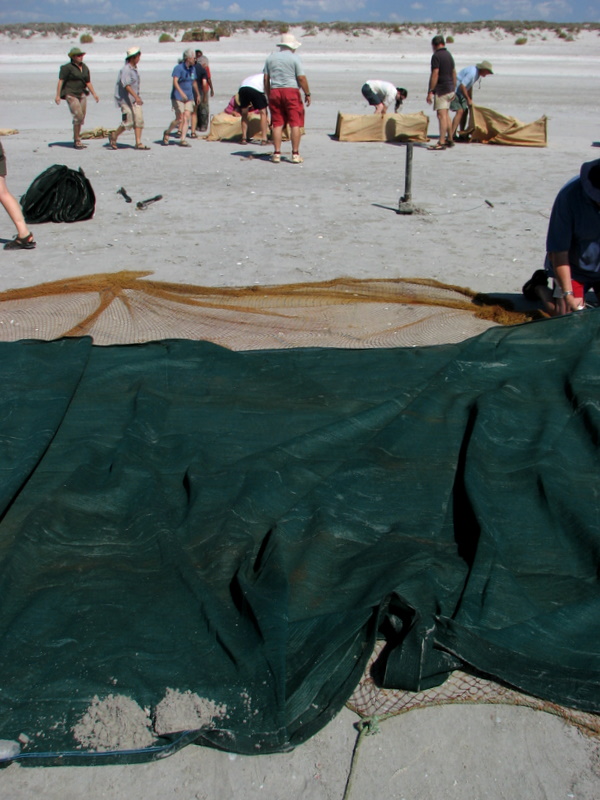
One of the main skills of securing a catch made with large-mesh is the preparation that takes place after the net fires over the birds and before extraction. This is most important if the tide is still rising and the net, with birds entangled, must be moved up the beach out of range of rising water. If the team lifts the net onto their forearms and pushes it up the beach (as is the procedure with small-mesh), folds will develop and the birds will become entangled in multiple layers of net. Extraction would be more complicated. A better way is to lift and push the net up away from the waterline while a second group pulls the back side of the net up-beach at the same time. This requires great presence of mind because the birds are still caught in the net by wings, feet and head. The process is not for the reluctant. The leaders must act quickly and decisively and the team must act with great coordination. Done well, as it is by Clive, Chris and Roz, the birds come out in excellent condition and ready to be processed.


Roz Jessop, Clive Minton and Maureen Christie direct the team to lift the net while they pull up the back end

After this procedure is complete, the birds are covered with shade cloth to calm them and keep them cool. Meanwhile, the teams work on setting up keeping cages. When cages are ready for birds, experienced extractors free the birds from the net and the rest of the team takes them to the keeping cages. After all birds are in the cages, shade cloth covers them to keep the birds calm and cool. On 80 Mile Beach, a 20-knot sea breeze is enough to keep the mesh-like cages well aerated and the birds cool. If there is no sea breeze, Chris directs the team to erect a shade tent built from poles and shade cloth. Then the scientific work begins.


The team covers birds in a large-mesh net with shade cloth


Keeping cages being erected after the birds are covered


After the keeping cages are erected, birds are extracted by experienced banders and taken to the cages in holding boxes or by hand


Finally, the keeping cages with birds are covered with shade clothe


Nick Ward holding a Marsh Sandpiper

Wednesday, November 28, 2007

Australia - Feather Molt - 80 Mile Beach WA, November 15, 2007


Red knot flight feathers. Primary flight feathers (or "primaries") are at the outer wing, secondary flight feathers (or "secondaries") are at the inner wing. The 10 primaries point more toward the wing tip while the secondaries point more toward the body (you can see this difference below the bend of the wing).

If dealing with the effect of heat on bird and team is the first major lesson of trapping in northwest Australia, the complicated wing molt of tropical non-breeding waders is the second. The heat, sun and wind wear down everything. For example the engraved leg flags on red knots and other shorebirds in the Delaware Bay have lasted for 5 years without significant fading of the unique alpha-numeric characters that indicate an individual bird. Here in Roebuck Bay, flags can fade within a year. What the elements do to flags, they also do to feathers. The impact is a highly evolved system of molt that allows birds to replace worn feathers and migrate when they need to with maximum aerodynamic efficiency.


Alice showing a newly-banded Bar-tailed Godwit


An adult Red Knot in the middle of primary molt

An average shorebird (everything varies by species) gets its first set of flight and body feathers the month after it is hatched. In July and August, young birds fly south to wintering areas which, for Red Knots in the Western Hemisphere, could be all the way to Tierra del Fuego at the southern tip of South America. In this, the Australia-Asia Flyway, a young bird flies to Roebuck Bay or 80 Mile Beach from its arctic breeding habitat, arriving in October or November. Most may skip the next migration north and may stay near the wintering area or make a partial northward migration. Although some start putting on a new set of feathers shortly after arriving in Australia, most birds wait and molt their juvenile flight feathers through the next July-August after their feathers become worn. Interestingly these same birds (now two-year olds) may start a second molt in the fall, so that when they are in-the-hand you may see feather molt starting at the inner primaries (at mid-wing), while looking at relatively new, fully grown outer primaries (at wing tip). The adults coming to Roebuck in the fall begin their molt in the fall. In any case, all molt is completed by January at which time all the second-year birds and adults use their new flight feathers to take them back to the Siberian or Alaskan Arctic.


Clive giving a lecture on molt in non-breeding shorebirds. Note graph of molt score on the easel


An adult Red Knot at least 3 years old in active molt (below), and a second year bird (above). The second year bird would have stayed in Australia throughout the northern summer of 2007 and started its primary molt long before the adults returned. Therefore its molt is in advance of the adult's; 9 of its 10 primaries are fully-grown and the outer 10th primary is about three quarters grown.

Another second year Red Knot in the midst of a second (or "replacement") molt -- unlike the adult the outer-most primaries (P9 and P10) are dark and relatively fresh while P8 is not yet completely grown. Note the primaries and secondaries look uniformly dark and fresh.

A science has blossomed around molt, not just for primary flight feathers (at the outer end of the wing called “primaries”), but including secondary flight feathers (at the inside of the wing called “secondaries”), flight feather coverts, body feathers, and tail feathers. They all contribute to a story that can reveal the bird’s recent history. There are suspended molts (a stressed bird may stop molting and is left with some new, completely grown feathers and the remainder are old feathers). There is a complicated naming system for primary molt ( P1 to P10 – inner primaries to outer primaries). There is a nomenclature describing the number of feathers in one of five growth categories that is bizarre but elegantly simple. It is written as one of the five growth categories raised to the power equal to the number of feathers in that category: 55, 42, 11, O2 = a bird with 5 feathers fully grown (category 5), 2 feathers that are more than 2/3 grown (category 4), 1 feather that is in "pin" (no feather has erupted), 2 feathers that are old (category "O" for old). Add the superscripts together and it equals the total number of primaries (10); multiply the superscripts by the growth stage, add all the products and you get a molt score. The molt scores can be plotted to describe the overall molt stage of birds at any time during the non-breeding period.

I admit I find all this hard to explain, but believe me it is truly hard to understand. Nearly everything I’ve just written varies by species, year, conditions, etc. But some people know molt sufficiently to be comfortable with any new combination of feather wear, color and growth stage to tell a story -- Clive, Chris, Roz and David Melville to name a few. In fact, it’s a bit like chess or a good murder mystery, a kind of game for intelligent people to describe a bird's past. Most of the veterans of these expeditions, like Humphrey Sitters, know molt well.

Molt is not usually an issue in the Delaware Bay because most of the birds are O10 (feathers are all fully grown and old after having molted the previous fall). However, molt has become key to unraveling the southbound flight of Red Knots on the east coast of the US. This August we trapped Red Knots in Stone Harbor, New Jersey, and they were in the midst of primary molt (55, 41 11 O3 for example). Additionally, most of the recaptured birds were from the catches we made in Florida in the last two years. One week later, we were trapping in Mingan, Quebec, a major southbound stopover for red knot, located on the north shore of the Gulf of St. Lawrence about 800 miles north of Stone Harbor. This stopover was recently discovered by Yves Aubry of the Canadian Wildlife Service. With Yves, we trapped a small group of knots that were all 010 -- they had not yet started their molt. In other words, they were on a completely different molt schedule than the Stone Harbor Birds. Also, those bird carrying leg flags in Mingan were from South America or Delaware Bay and none from Florida. Thus, molt and resightings suggest that the birds in Mingan and Stone Harbor represent different non-breeding populations – those in Mingan go to South America, those in Stone Harbor go to Florida. In this way, molt can often unravel complicated bird life histories.


Google Earth map of US East coast showing Stone Harbor, New Jersey, US and Mingan, Quebec, Canada

Monday, November 26, 2007

Australia - 80 Mile Beach, WA, November 17, 2007

Oriental Plovers (foreground) and Grey-tailed Tattlers on 80 Mile Beach

We left Broome, successful to the extent that we had caught over a 1,000 birds, with sufficient samples of a number of species and few mortalities. It was a remarkable feat considering the heat. Clive, Chris and Roz along with Pru and Maureen helped the team members increase their skills while also making bold and decisive actions to catch then and care for all the birds.

As usual, success depends on persistence. One could look upon the thousands of shorebirds at Roebuck Bay and conclude that dropping a net anywhere will yield thousands of birds. Unfortunately, it was not that easy, and our last catch at Broome was a case in point. Several times we were close to firing only to have the flock fly off under the threat of a roving avian predator, a Brahminy Kite, a White-bellied Sea-eagle, harriers, Brown Falcons. If new to the experience of trapping birds, you would conclude it was impossible. But persistence paid off and we ended with a significant catch of Godwits.

Clive Holding a juvenile Bar-tailed Godwit showing distinctive wear pattern of juvenile plumage (scalloped tertials)


The following day was spent packing and moving off to 80 Mile Beach. It is the second study site of the expedition, a site that is virtually unimaginable to a person used to summers at the Jersey shore. Clive, Mandy, Brian and I went off early to do reconnaissance for the next day’s catch. After arriving at Anna Plains Station, we quickly established our rooms and set off for the beach. A “station” is the Australian term for ranch – Anna Plains has 18,000 head of cattle. We snaked our way through the grazed, but otherwise untouched, flat eucalyptus forest (Pindan forest) and grass plain through the extensive dunes (about 1km in depth) then out to the most remarkable beach I have ever seen. Winding away in both directions out to the horizon and out of sight was a wide sandy shore that would put to shame any New Jersey beach. Standing on the dunes one could look out over a shell filled sandy beach of about 100 to 800 m or more and in the distance a turquoise sea blending into a brilliant blue sky unaffected by humidity. Why it is called 80 Mile Beach is anybody’s guess -- it is actually nearly 155 miles long, more than the New Jersey shore from Sandy Hook to Cape May (exit 130 to exit 0 on the Garden State Parkway). And along that entire length stands not one house!


A map comparing NJ beachfront with 80 Mile Beach. NJ beach is 124 miles long, 80 Mile Beach, despite its name, is 155 miles


Our Landcruiser driving onto the beach


Red-necked Stints flying along side our moving vehicle

However, one would not want to lounge in this Indian Ocean surf. Predators lurk in the in the water between the turquoise sea and the sand beach. Chris Hassell said that you don’t have to worry about salt water crocodiles at 80 Mile Beach because the sharks ate them all. We did see small sharks lazily patrolling the water close to the shore, although they were actually non-threatening shark skates. Then there are the jelly fish that can leave you in pain for days, or sea snakes, or sting rays and, despite Chris’s assertion, the occasional crocodile. Fortunately, a powerful sea breeze develops in the late morning that counters the mild prevailing easterly winds and cools the beach down to a languid 100 degrees F -- on some days the easterly desert winds prevail and the temperature easily reaches 43 degrees C (about 110 Farenheit) accompanied by a plague of flies blown in from the interior.

Larry sitting in the hide with gobs of flies on his back


Ghost Crab on 80 Mile Beach


White-bellied Sea-eagle on 80 Mile Beach


We started our surveillance at about high tide (1:30 p.m.). Bar-tailed Godwits, Great Knots, Grey-tailed Tattlers, Greenshanks, Terek Sandpipers, Red-necked Stints, Grey Plovers, Red-capped Plovers and more extending as far as the eye could see even after we had driven for more than 40 km along the shore. Chris, working with Allan Baker and Theunis Piersma, conducts surveys on the beach and regularly counts 490,000 shorebirds.

A foreshortened picture of shorebirds on 80 Mile Beach


A flight of Bar-tailed Godwits and Great Knots on 80 Mile Beach

After our survey, we went back to the station. Run by John Stoate and his son, the station is a picture of efficiency and function and at the same time a wonderfully elegant oasis of water, shade, and green in the otherwise austere Outback surrounding it. The Station nearly a 1,000,000 acres, 100 km along the beach and 40 km inland, supports only 18,000 head of cattle and small group of horses. The Stoate family operation raises cattle from birth, keeps them until one or two years old and then sells them to buyers in Malaysia for fattening and ultimately slaughter. The family runs the operation from beginning to end and by all appearances it is a profitable operation. Sitting on the veranda of our house, one of about 10 on the station, I can actually see the heat building in the grassy fields and Pindan forests surrounding us. Yet I am cool. We begin trapping today.

Anna Plains Station


Cattle and Brolgas on a wetland created and maintained by the Station for waterbirds

Australia - Roebuck Bay and Broome Bird Observatory, WA, January 14, 2007

Hermit crabs are plentiful on Roebuck Bay


Over the last two days we made two catches of over 300 birds each. On each catch the skill of both Chris and Clive, and the growing capability of the team, helped to make well executed and safe catches. Yesterday we made a catch of 378 birds including Red-necked Stint, Great Knot, Red Knot, Oriental Plover, Bar-tailed Godwit, Greater and Lesser Sand Plovers, Curlew Sandpiper, Terek Sandpiper, and Broad-billed Sandpiper. I was especially grateful to work with Frank O’Connor on Terek Sandpipers, a species I had never seen let alone handled and banded. The technique was similar to the first day, a net set high just above the high tide line and a second several meters down-beach meant to catch birds two hours before high tide. In this, our second catch at Roebuck Bay we caught on the low net; on the third catch we caught on the high net.

A net set on Roebuck Bay beach (the three cannons and net are just visible on the beach as three sandy "lumps" and a mildly-disturbed area just right of the lumps in the foreground)


The latter catch (our third) was thwarted by all that could go wrong. At first, we had a nice potential catch of Grey-tailed Tattlers and Ruddy Turnstones, a rarity that would improve species coverage. Frank O’Connor, Nik Ward, and Naoko Takeuchi, operating on beaches as far as 2 km away, slowly moved (or “twinkled”) the birds to the net position; when close to firing, an Osprey flew low over the beach and landed right in the catch area flushing birds in all directions. The advancing tide forced us to rescue the low net necessitating a switch to the high net. After some quick-but-judicious twinkling we soon had birds in front of the net only to see a young aboriginal boy, fishing with his father, walk over to the flock chasing it away.

Still we persisted and, after a short problem with Brahminy Kites, we once again had about 400 birds in front of the net. This time Pete Collins occupied the young boy, we fired and made a good catch of Bar-tailed Godwits, Great Knots, Red Kots, Red-necked Stints, Greater and Lesser Sand Plovers, Red-capped Plover and Curlew Sandpiper.

Two Brahminy Kites looking over the birds in front of the net


Although one would have to be impressed by the skill of the leaders and the group during the entire process, the real expertise comes after the catch. Envisage a heat so great that you could actually fry eggs on a rock, a soft wind that feels cooling actually drains you of all your liquids so much so that you don’t pee all day despite drinking gallons of water. Now imagine hundreds of birds struggling under the net under the searing tropical sun. On any catch one must be concerned with the usual problems: safety of the birds from the powerful leading edge of the net, a “wet catch” where birds are captured at the tide edge and could drown if not quickly secured, birds escaping from an improperly secured net, birds suffering stress because of slow post-catch handling or covering. Here at Broome, you still have those difficulties, but the greatest threat for human and bird is the heat. Over the last 30 years Clive, and more recently Chris, have developed strategies and methods to prevent problems, many of which we have copied on Delaware Bay. With experience, it looks like a well-choreographed dance. As soon as the net is fired, the team races to the front (or seaward side) of the net. With the leaders at the back (or beach side) of the net barking instructions, the team – shoulder-to-shoulder -- uses their arms like a long, linear fork lift to swiftly move the net up and away from the tide. With a small-mesh net, birds do not become entangled, and the team lifts (or “tents”) the net so the birds can run up-beach toward the back of the net. Then a large shade cloth, like that used to shade greenhouses, is spread over the birds and net -- the immediate effect is to first calm the birds and then shade them from the sun.

Holly Sitters, Assistant Warden at the Broome Bird Observatory, transporting Red-necked Stints to keeping cages


While this is happening, a smaller group erects keeping cages of coarse cloth that are high enough to allow easy movement of taller birds, like godwits or curlews, and are well-ventilated to allow the body heat of the birds inside to be dissipated. The team then extracts all birds and places them in separate compartments according to species. Within minutes of securing the catch in keeping cages, Chris directs the team to cover all the cages with shade cloth. Immediately afterward, the team erects shade tents that will shade both the keeping cages and the team during processing. This whole procedure is usually complete in 30 to 40 minutes. By the time processing (banding, weighing, measuring) occurs the birds have preened and are cooler than if they were roosting on the beach. Processing can then take place without hurry and with the care and precision necessary for good science to occur.


The keeping cages are first covered with shade cloth . . . .

. . . .then a shelter of shade cloth is erected to cover the keeping cages and crew


Chris Hassell measures head and bill of an individually color-marked Bar-tailed Godwit -- a new bird for his ongoing research


Yahkat Barshep from Nigeria, a Ph.D. Student at the University of Cape Town, South Africa, and David Melville of New Zealand processing Great Knots


Peter Jenkins weighing a Red Knot


We were grateful to Chris and Maylee for taking us to Lake Eda for an early-morning field trip. The lake is one of few freshwater habitats and so attracts thousands of shorebirds, waterbirds, waterfowl, and raptors. We were also grateful to both Clive for his lecture on on Australia-Asia migration range mapping and to Dick Holmes for a talk on shorebird breeding ecology.

Nailed-tailed Wallaby near Lake Eda


Australian Pratincole at Lake Eda


Dick Holmes presenting an evening lecture on the evolution of shorebird breeding behavior

Australia - Broome and Roebuck Bay, WA, November 12, 2007

Red "Pindan" soils and limestone formations surrounding Roebuck Bay, near Broome in Western Australia


Within an hour of our arrival in Broome, we met most of the 30-member team -- our colleagues for the next ten days. Clive Minton leads the group as he has done for the last 28 -- years ever since he drove the dirt road that led from Alice Springs to Broome and discovered one of the largest populations of wintering (nonbreeding) shorebirds in the world. Clive began catching shorebirds at Roebuck Bay and 80 Mile Beach in 1980. By 1988, he and other members of the team created the Broome Bird Observatory (the “BBO”), our home for the next five days http://www.broomebirdobservatory.com/

For a complete list of wintering shorebird species and detailed descriptions of the marine and terrestrial ecology of Roebuck Bay and 80 Mile Beach, see the RAMSAR descriptions for these sites: http://www.naturebase.net/content/view/814/870/

Clive Minton (left) and Ji Qui with a Bar-tailed Godwit


We were all to meet in the 'shade-house' of the BBO, which has a tin roof and fly-wire walls. BBO consists of about 10 buildings spread amongst the Pindan forest on the edge of Roebuck Bay -- a turquoise sea ringed with mangroves and red sand beaches. Pindan is the name of the red soils of the region. Throughout the year, but especially in the dry season (roughly April to November), the BBO hosts tourists, birders and campers, all hoping to get intimate with the gorgeous subtropical wildlife, especially the birds. The BBO follows the pattern of bird observatories in the UK and Europe; managed by a committee, and run by a warden, Pete Collins. Holly Sitters, Maylee and Naoko Takeuchi are deputy wardens. The compound can house and feed our entire crew in comfortable conditions that include showers, refrigeration, good drinking water, and there is even air-conditioning in some of the chalets. The showers are indispensable.

Northern end of Roebuck Bay with Mangroves


Bar-tailed Godwits and Great Knots on the shore of Roebuck Bay

Chris Hassell, who came to the Delaware Bay in 2006, once ran the BBO and now runs the cannon-netting operation of the expedition (under the eye of the always-watchful Clive). Chris conducts research on shorebirds in Broome in collaboration with Theunis Piersma of the Royal Netherlands Institute for Sea Research, and Allan Baker of the Royal Ontario Museum, Canda. Chris leads a team that cannon nets shorebirds throughout the year. His partner Andrea, a business consultant, volunteers her time to serve on the BBO Committee and the cannon-netting team.

Chris Hassell and his partner, Andrea Spencer, at their home in Broome

A group of Aussies from around the continent anchor the expedition. Roz Jessop, Maureen Christie and Pru Wright are senior members of the 15 Australians on the expedition. They are supported by volunteers from around the world including New Zealand (2) China (4), England (3), US (4), Nigeria (1), and Japan (1). A number of these people have come to the Delaware Bay to help with our shorebird research including Roz, Peter Fullagar, and Alice Ewing. Dick Holmes of Dartmouth College in New Hampshire joined the team for a week, Sue Rice from US Fish and Wildlife Service in Virginia is also here. Seems that most people working on shorebirds throughout the world -- for any length of time -- come to Broome at one time or another, many repeatedly.

Jing Li holding a bird caught in Roebuck Bay, originally banded in China

After a luscious dinner of lamb, Clive and Chris hosted a two-hour program that provided the team with the basics, food issues, trapping schedule, camp care, etc. We were in bed by 10:00 p.m.

At 6:30 a.m. the next morning we were out at Richards Point on Roebuck Bay just north of BBO and south of Broome. We set two nets, one below the high tide line, which was expected to flood at about 12:00 noon, and a second just above the high tide line. The low tide set is unusual and a result of experimentation by Chris in the time before the team arrived. The morning air was unusually cool for this time of year, according to the veteran team members. To me, it felt hot and getting hotter by the minute. The 7.6-meter tide rushed in too fast to use the low net, and everyone moved into rescue the cannons and net from flooding. But within an hour we had a catch of 296 birds in the high-tide net.

Chris and Clive working on out a position for the net in early morning at Roebuck Bay


Mandy twinkling birds from the back of the net to move them out of the danger zone – the two-meter zone in front of the net necessary for the leading edge to clear a standing flock


The cannons being fired and . . . . .

. . . . .the net going out over the birds

We had already erected keeping cages so retrieving the birds from the nets and placing them into the cages took about 20 minutes. The next 30 minutes was spent protecting the birds and the crew from the hot sun. When Clive asked us to come Broome, he said I needed to do this to “complete my cannon-netting training”. Although one can spend a lifetime catching birds and not complete a cannon-netting degree, I soon learned what Clive meant. Our next catch would provide a more graphic example.

The team at the net ready to secure the edges, concentrate the birds at the top of the net, then lay shade clothe on to calm the birds and keep them cool.


The team processing birds under a secure tent to shade both humans and birds from the relentless heat


Peter Fullagar holding a Greater and Lesser Sand Plover


A Terek Sandpiper


As is the custom, one of the team presents a lecture on either something relevant to the expedition or on results of personal research. Adrian (“Addie”) Boyle presented a collection of his photographs of birds of the area.

The team is treated to an outdoor presentation of Addie's bird photos

Additional References:

Life Along Land’s Edge: Wildlife on the shores of Roebuck Bay, Broome. By D. I. Rogers, T. Piersma, M. Lavaleye, G. B. Pearson and P. de Goeij. Published by the Department of Conservation and Land Management, Western Australia. 162 pgs.

Available through the Broome Bird Observatory website (see above), select the link "life along land's edge".

Saturday, November 24, 2007

Australia - Kakadu National Park , NT, to Fitzroy Crossing, WA, November 10, 2007

Nourlangie, a outlier of the Arnhem Land escarpment of red sandstone, in Kakadu National Park, NT


After a short ride from Kakadu National Park, we pulled into the town of Katherine and, after a quick re-supply, took the paved road to Katherine Gorge National Park. The Northern Territory (an Australian state) manages the park even though it is the province of the national government. In the US, it would be like the State of NJ running Gateway National Park, or Forsythe National Wildlife Refuge. Although a consequence of the relatively recent confederation of Australian States into a national federation in the early 20th century, the arrangement has some merit.

First gorge at Katherine Gorge National Park


A Blue-faced Honeyeater and . . . . . . .


Rainbow Lorikeets in Katherine Gorge National Park

Giant termite mounds along roadside between Kakadu National Park to Katherine Gorge National Park

In the US all national parks, refuges and forest lands are managed to a nationwide standard by the federal government. The consistently high standard of our national parks and refuges results from this uniform federal management. It also leads to the imposition of a style of management or governance that sometimes conflicts with local custom often leading to confrontation. An alternative, presented in Australia, is the creation of a national standard that is implemented by state governments but monitored by federal authorities. After a quick tour of the park we set up camp in the well-kept campground run by a concession in the park.

Mandy shooing a Wallaby, a bit too habituated to humans, out of our campsite in Katherine Gorge National Park

We intended to take the river cruise but chose instead to rent kayaks (at a lower fare and for a longer period). We spent most of the day wandering the gorge, rich with birds like the Rainbow Lorikeet and the Blue-faced Honeyeater, At the end of the first Gorge (there are 13) we came to a cliff with aboriginal paintings over a thousand years old.

Kayaking in Katherine Gorge


Cliff paintings by an Aboriginal artist made over a thousand years ago


Dragonfly in Katherine Gorge

We stayed the last night of our journey across Australia at Fitzroy Crossing in Western Australia. Coming in late, we decided to have a celebratory dinner; the next day we would be in Broome after traveling 6,600 km from the southeast corner of the continent to the northwest. Fitzroy Crossing Lodge is the first thing you will see coming in to the town and it’s beautiful buildings and lush grounds would make you wonder what more lies in this very isolated town. The next day we found the town offered little else than the normal road house towns that dot the bush landscape.

Two large Boab trees on the road to Fitzroy Crossing

After a brief late morning visit to Gieke Gorge under a sun that made the sand unbearably hot, we jumped into the river vigilant for freshwater crocodiles (although they are not dangerous to humans). The final leg to Broome was through one of the most remote sections of our trip -- through the Western Australia Kimberley Region. It was ravaged by fires and as hot as an oven. Over one stretch of 400 km (more than the length of NJ) we came across just one road house (= glorified gas station!).

A threatening rainstorm over a smoldering fire. The rains marked the beginning of the wet season in northern Australia

Gieke Gorge National Park


Smoky woodland on the road to Broome

We first saw the turquoise waters of Roebuck Bay near the Broome Bird Observatory at about 5:00 p.m. -- we promised Clive we would be at there at 4:00 -- after a 6,600 km journey of ten days, we were only 1 hour late!

Sunday, November 11, 2007

Australia - Edith Falls to Kakadu National Park, NT, November 6, 2007


Roadside warnings about swimming near Kakadu National Park, Northern Territory, Australia

We stayed Sunday night at Edith Falls National Park, just north of Katherine, and got a quick lesson in Australian ants. Our first acquaintance was at Devils Marbles. While Mandy raised the tent, I started dinner on the portable gas grill. Beneath us roamed the occasional ant. I sautéed the vegetables and grilled some meat, looked down at my feet and was surprised to see ants crossing in all directions in an area about 10 square feet. They posed no problem, so I attended to the food. In a short time, I looked down again to see the squad of ants turn into a small army that covered much of our camp. Still they seemed to pose no problem; they had no interest in food (although we tentatively identified them as “Meat Ants”). We went into our tent that night with some trepidation.

Our camp site at Devils Marbles

The next night at Edith Falls National Park we went through the same process and soon found the ants were out again -- this time tiny red ants smaller than a small flax seed. These, however, were interested in the food, the greasy pans, and us. The next morning we found them into nearly everything including a trash bag inside the truck. The fact that they were smaller than the mesh of the tent screen gave us an even greater fright than the night before. Fortunately our fear was unfounded although, sadly, they found Mandy’s chocolate also stashed in the truck. We learned the next day that Northern Australia has over 200 species of ants.

Nasty little black ants invading our food . . . so small they can (and did) slip through the mesh screening of our tent.

The ants are an amazing variety of sizes and colors -- these ants were gold and green.


Bush Stone-Curlews at Edith Falls National Park with chick in the leaves on the lower right.

The ants were a fright, but the heat hit us like a hammer when we stepped out of the air-conditioning of the Land Cruiser in Katherine. Imperceptibly we slid from cool to burning hot in about a five-hour ride nonstop through Tennant Creek to Katherine (we found out later that the cool morning at Devils Marbles was a fluke). By the time we set camp in Edith Falls it was steamy.

Thunder storm moving over the Monsoon Forest at Kakadu National Park

So the next night, we decided to luxuriate at Kakadu National Park and stayed at the Park’s Cooinda Lodge. It was cool, ant free, with two swimming pools, a bar and crowded with happy tourists. It was well-run by the Aboringinal owners of the land -- the lodge and all the concessions.

Little Corella near the Cooinda Lodge, Kakadu NP


Australian White Ibis feeding outside our room at Cooinda Lodge

Early next morning we met Buck Salau, a field supervisor of Feral Species Team in the Department of Environment and Water Resources Service. Buck agreed to show us around Kakadu National Park and discuss his work and the operation of the park. It’s an odd arrangement. In the US a park is either federal, state or local and, at least in my experience, has no dual authority; a federal land is run by federal staff and likewise for state and county lands. In Kakadu the Australian National Government granted the aboringinal people a land claim that included the park in 1982. The Government then leased it back from them. The Aboriginal groups essentially run the park to the extent that it is they who greet visitors to what is their park and it is they who earn the income. Buck explained that the profits go to businesses run by aboringinal groups or their proxies. Yet for all intents and purposes, the employees one sees are government staff or employees of the concessionaires. While explaining all of this, Buck guided us through billabongs (rivers isolated by dry lands) and spring-tide flooded wetlands full of wildlife.

Buck Salau showing us a wetland at Kakadu National Park


Closeup of the waterlillies


Dancing Brolgas on a tidal flat shown to us by Buck Salau


The relationship of private enterprise and the government is another interesting aspect of these lands; there appears to be a near seamless coexistence of both employees of the government and employees of the concessions. By all appearances it works well, the park appears to be carefully managed to protect both the ecological and cultural resources and the lodge is clean and I assume profitable, being full in this the off-season. As a former employee of state government, and knowing how difficult it is to run parks in the US, there is a lesson to be learned from this effective linkage of private enterprise and government lands.

As if to make the point we finished the day on a boat tour of the South Alligator River, run by an aboriginal concessionaire. The operator provided the 40 or so tourist with an intimate experience with White-Bellied Sea-Eagles, Azure Kingfishers, Darters, Whistling Ducks and thousands of Magpie Geese without creating any apparent disturbance or impact. But the star of the tour were the salt-water crocodiles, which gave everyone a memorable experience despite the trip being cut short by a violent thunderstorm.

A Darter at Yellow Waters in Kakadu NP.


Crocodile resting along a bank of the South Alligator River


A White-Bellied Sea-Eagle nesting along the South Alligator river, the tour boat loaded with 40 people never flushed one of the 6 individuals seen on the tour.


A Comb-crested Jacana walking on the lily pads of the South Alligator R.

Friday, November 9, 2007

Australia - Port Augusta, SA, to Alice Springs, NT, November 4, 2007

By day three we flew through fertile southeast Australia and pushed into the barren deserts in the center of the continent. The contrast couldn’t have been greater. In both places, phrases like “up the road apiece” mean nothing. For the most part nothing lies up the road and the distance between places keeps getting longer. In the south there are vast grain fields sprinkled with vineyards producing the wines we all enjoy in the US. Traveling north farmed fields give way to desert used to graze cattle and sheep. Where a drive from Port Augusta to Alice Springs seemed a short leg of our journey, it was in reality equivalent to the trip from New Jersey to northern Florida (~740 miles). In all that distance spanned an immense dry land dabbled with shades of gold, green and red. Our greatest hazard was plowing into a stray ranch animal or a hopping kangaroo. We could tell the tourists from the locals by the iron-work that guards the front end of their vehicles from these otherwise lethal hazards.

Larry on a dry salt lake north of Port Augusta.

A “Road Train” or group of up to four trailers behind one diesel tractor.

After Port Augusta the desert stretched on for 1,000 miles. In between are a few small towns like Coober Pedy, a dusty, opal-mining town and the subject of at least a couple of Outback movies. But mostly the vast wilderness is broken by small settlements surrounding roadhouses – places to gas up, have a pee, or sleep.


An opal store in Coober Pedy

Camel/car on its way to Alice Springs


We had hoped to cover this section of our journey quickly to get on to Alice Springs and areas north but found ourselves engulfed in unprecedented drenching rain and violent thunderstorms. All of our Australian hosts warned us it would be dry and hot, but we found it cool with so much rain that the road at times was a sheet of water that dragged us down to a crawl. By late afternoon, it was clear that we were not going to make it to Alice Springs before dark, something we were warned against. Or we could camp, in what promised to be a torrential rain, rapid-fire lightening and thunder. We choose to press on.

The sky was electric with lightening in nearly every direction. The rains flooded the land, drained into the waterways that in turn flooded the roadway. Prominent “Floodway” signs marked low places where water crosses the roads, some with upright guages marking the depth up to 1.4 m above the road surface. While slowly ploughing through the flooded road we could here frogs or toads singing loudly, surprising in such a normally dry place. For much of the distance to Alice Springs, small toads sat on the pavement obviously expecting us to avoid hitting them. We inched our way over the last 200 km to Alice Springs driving slowly, with high-beams, on a constant vigil for kangaroos that never appeared. If it weren’t for all the road kills you would have thought they didn't exist.


A thunderstorm bearing down on us from the north, darkness falling and Alice Spring still 200 km away.


Flooded “floodway” on the road to Alice Springs after a downpour that last for nearly two hours

After a night’s stay in an Alice Springs motel, restocking supplies, gas and a “flat white” (coffee made with milk), we moved on toward Katherine. The land around Alice Springs and north is dramatically different from the more southern desert. A number of mountain ranges wind their way across the desert. The Davenport and McDonnell ranges practically glow in the sunny sky broken by dark clouds – the remnants of the previous day’s storm. In this area of scattered aboriginal lands we saw our first groups of native people. Not unlike the Inuit of Canada they seemed deprived, almost displaced in this land of white people. Only a few hours north of Alice Springs, we came to the Red Sands Art Gallery located in the small settlement of Ti Tree. The gallery features work by many local aboriginal artists from the Central Desert and Utopia Homelands.

We spent our first night camping at Devil’s Marbles Conservation Reserve. Clouds gathered then dispersed through the night and by the next morning the sky shone bright and warm. All-in-all we felt fortunate to experience this land after a cooling rain.

One of the the many rock formations at Devil's Marbels Conservation Reserve


On the road to Tennant Creek


Australia - Melbourne, VIC, to Port Pirie, SA, November 2, 2007

For the last seven years, our shorebird blogs have focused on our work in North and South America, from the tundra of the Canadian Arctic to the pampas of Tierra del Fuego. This blog will be different. Although eventually it will describe a shorebird expedition, this time to northwest Australia, it will also describe our journey from Melbourne in southeast Australia, to the expedition site in Broome. Broome is about as far as one can get from Melbourne so our trip will lead us through some of the most remote areas of Australia. When we arrive we will join a group led by Dr. Clive Minton. Each year he assembles a team of volunteers (including amateurs and professionals) from around the world to cannon-net shorebirds at Roebuck Bay and 80-mile Beach. These expeditions can last as long as three months, this expedition will last about 3 weeks. We, however, will join the expedition for just the first ten days.

Clive, who taught us everything we know about catching and banding shorebirds, has been working on shorebirds since his childhood in England, more than 50 years ago. Although expert in most forms of shorebird study, he invented and refined the modern techniques for capturing shorebirds using cannon-nets. Clive started this work in England and brought it with him when he migrated to Australia where his shorebird studies and conservation efforts are so widely recognized, he was bestowed with the Order of Australia, an honor equivalent to being knighted in England.

Our journey began at JFK airport in NY on October 28 with a flight to Los Angeles, an unscheduled stop in Brisbane caused by a plane malfunction, then to Sydney and finally to Melbourne where Clive lives. After our 32 hour journey and a long nights sleep, we began packing for our 10-day trip across the heart of Australia covering 5,000 km. Clive graciously offered us the use of his Toyota Land Cruiser, a mighty vehicle up to the task.
But before our start, the co-leader the Broome expedition, Ros Jessop, invited us to Phillip Island Penguin Conservation Center where she studies and protects the Little Penguin.

Coastal islands called the "Nobbies" off Phillip Island, Victoria, Australia

A Wallaby on the grassy bluffs of Phillip Island


The Little Penguin spends most of its time out at sea feeding, but when breeding the foot-high birds come ashore at dusk at the edge of the sea, cluster into groups and courageously march across the open beach to burrows hidden in the dunes. Since 1923, the Australian National Government and Victoria State Government have nurtured this remarkable natural event into one of the most unusual and successful wildlife tourism opportunities in the world. Each evening, up to 4,000 people populate stands built into the dunes and watch the march of the penguins while park staff describe their life-history and answer questions in at least a half dozen different languages. Boardwalks lace the dunes providing adults and children rare access to intimate courting behaviors without impact to the birds.


The stands fill for the evening "Penguin Parade"


Roz Jessop near the Penguin Foundation display

What impressed us the most about this operation was its scale – the Foundation not only educates but entertains thousands of visitors nightly. There are exhibits, games, food, even a green screen studio that allows visitors to be photographed surrounded by virtual penguins. This more than makes up for the prohibition on flash photography. Wisely the Victorian government allows the Foundation to keep the funds raised providing the basis for their conservation work and the incentive to do it well. One can’t help thinking that within this operation lies a productive model for the conservation of shorebirds on the Delaware Bay.


The next day, Clive and his wife, Pat, graciously helped us prepare for our 10-day journey across the Outback -- an adventure when prepared, a disaster when not. For those readers who know Clive, he was "in his glory" helping us pack for the trip he has taken many times before, right down to the precise arrangement he favors for postitioning boxes across the back seat to allow meals without stopping, and a timetable with daily targets to be achieved each day. When we described this to Roz, she said “oh yeah, just ditch that . . . . On second thought, keep it so that you know where you are supposed to be when you call in to Clive”.

Pat Minton feeds a Magpie


Clive prepares the Land Cruiser for the journey north


By 7 a.m. on Thursday, November 1, we were off. On our first day, we fell short of our goal by 400 km!!

Monday, July 9, 2007

Canada - Victoria Island, Nunavut, Wednesday, July 4, 2007

We spent the last day in the field re-surveying Mt. Pelly for red knots. With the coordinates of the three nests found in 1999-2003, we used GPS to cover much of the area we had surveyed at the start of the trip but without success. We went back to Mt. Pelly that evening to listen for knots, but still no luck. We stayed to watch the sun, still far from the horizon even though it was nearly 11:00 pm, but eventually a strong cold wind drove us back to camp.

Gwen pointing out a red knot nest cup on Mt. Pelly occupied by a breeding pair in 2001, (see silver coin in the bottom of the nest cup)

After a day breaking down camp and packing, we moved back to Cambridge Bay in preparation for our long flight home. Breaking camp after eight days is a bit like moving house, but using ATVs instead of a van. It took two trips with four ATV’s to move everything back to town.

Our trips to the Augustus Hills, Lady Pelly and Little Pelly had taken us through Cambridge Bay three times. This allowed us to have much more interaction with the towns folk than on our previous expeditions to Southampton Island and King William Island. There, we were in complete isolation the whole time. This time we were fortunate to experience life in a predominately Inuit town and get to know some of the people. Peter Laube, his wife Helen Koaha and their lovely children, six in all, rented us the ATV's and graciously provided logistical support. It was unexpected and greatly appreciated. Peter and Helen typify the independent and entrepreneurial spirit of the people in this remote arctic settlement, running both a rental business and a construction company.

Helen, Peter and their children.


Cassidy, Georgia, Kalene, Brandy, Jonhenry, Dyson, Madelaine


Cambridge Bay (population around 2,000) is growing slowly, both from the natural increase in the resident population and also from increased mining activity in the surrounding area. Most of the town’s income appears to come from natural resources (guides and logistics for hunting, fishing, birding, etc), from mineral resources (diamonds, gold and other precious minerals), and from commerce -- supplying the needs of the people and the government (community, Provincial and National Governments). The extraordinary isolation (it is a three-hour flight to Yellowknife, NWT, the nearest large town), the extreme climate (-30 to -50°C in winter is not uncommon) and the otherworldly effect of daylight all through the night in summer makes Cambridge Bay a truly unique place and afforded a wonderful experience that touched us all. The people of Cambridge Bay deserve to feel proud of what they still call their “hamlet”.

As mentioned earlier we also had the good fortune to meet Rob Harmer, one the Nunavut Conservation Officers for the region. Although the entire team felt gratitude to Rob for his assistance and direction on all matters regulatory, Mandy and I felt a special connection with a fellow provincial (= state) conservation professional. Rob’s job is not unlike that of our own Conservation Officers in NJ and works for an organization similar to NJ Fish and Wildlife. But, of course, Rob deals with polar and grizzly bears, -50°C temperatures, as well as the best (and worst) hunters, birders, photographers and researchers from the rest of the world. He displayed a keen knowledge and understanding of the wildlife, the land and its people. He represented his agency well and with professionalism.

Much of our time in the field was spent in places of spiritual significance to the Inuit, and this helped us to gain some access to their culture. They say that the three hills, Mt. Pelly, Lady Pelly and Baby Pelly, arose from the dying bodies of three gods that could go no farther in harsh conditions. Although our team covers the gamut of religious background and commitment, we all felt an organic connection to the land and honored the sanctity of the areas we searched. There is no need to attend church when on Mt Pelly, Lady Pelly or Baby Pelly, you are in church. It made the loss of red knots all the more poignant.

Our entire team is grateful for the hard work of Dr. Humphrey Sitters, who edited this blog and Phillipa Sitters for putting it up on the internet while we were gone. The same goes for Steve Gates, who help us get ready for the trip and with Satellite phone communications. They are long-term members of the team who for personal reasons could not make the trip. They were missed.

As said above, we are also thankful to Peter Laube and Helen Koaha and their family who own and run Kalvik Enterprises, Inc., in Cambridge Bay. If anyone is interested in equipment & ATV rentals, contact Kalvik Enterprises (867) 963-2922. Also thanks again to Rob Harmer and Shawn Sather, both conservation officers that can be contacted through Nunavut Department of the Environment in Cambridge Bay.

Funding for this trip came from New Jersey Division of Fish and Wildlife and the New Jersey Natural Lands Trust in the Office of Natural Lands Management, both in the Department of Environmental Protection. Funds also came from The Conserve Wildlife Foundation of NJ which also provide logistical support for the trip. The Delaware Fish and Wildlife, Department of Natural Resource and Environment Control provided funding. We are especially thankful to people of these groups Dave Chanda, Dave Jenkins, Bob Cartica, Michael Catania, Margaret O’Gorman, Karen Bennett.

The 2007 Victoria Island Crew (L to R, top to bottom): Bruce Luebke, Michael Male, Gerry Binsfeld, Mark Peck, Georgia Peck, Larry Niles, Mandy Dey, Gwen Binsfeld.